Got to take a tour of the DMZ last week, unfortunately there was some sort of security trouble and I was not able to exit the bus at the JSA. The DMZ is a fascinating place. It's the most under-developed place I've been to in Korea. It's probably not much different now than in the 50s.
The history of the DMZ is as interesting as the place itself.
The Korean DMZ is a buffer zone between North and South Korea. It cuts the peninsula roughly in half crossing the infamous 38th parallel. It is 155 miles long and approximately 2.5 miles wide although much narrower in some places (especially near the Joint Security Area or JSA). It is regarded as the most heavily armed border in the world. The ceasefire that ended full-scale fighting at the end of the Korean War and created the DMZ was signed 27 July 1953. Each side agreed to pull their troops back 2000m from the front line, this created a buffer zone 2.5 miles wide. The Military Demarcation Line or MDL goes down the center of the DMZ and is exactly where the front was the day the cease fire was signed. Technically the two sides are still at war and large numbers of troops are stationed along the DMZ. The armistice only allows certain types of weapons and a specific number of troops allowed in the DMZ. Both sides are free to patrol the DMZ but cannot cross the MDL. Sporadic outbreaks of violence between the North and South due to northern aggression have killed over 500 ROK soldiers and 50 US soldiers from 1953 to 1999. There have been several notable incursions in the DMZ to which the North Korean government has not recognized any responsibility for.
Three tunnels dug by the North have been discovered in the mid-Seventies and a fourth in 1990. They were discovered with the help of a North Korean defector that worked on the tunnels. Two of the tunnels are large enough for tanks and the smallest one (open to the public) is for personnel only. The North Koreans claimed that they where coal mines, even smearing coal on the walls of the tunnel. It is believed there may be up to 13 undiscovered tunnels in the DMZ. It is estimated that a brigade-sized element could be moved through the tunnels in 45 minutes.
We got to go into the third tunnel (the personnel one), but no pictures were allowed. It’s very low and I had to duck my head down the whole time. It dead ends at a concrete wall put up at the point of the MDL.
On 18 August 1976 a group of Korean civilians escorted by a security team commanded by CPT Arthur Bonifas and his ROK Army counterpart CPT Kim and one of CPT Bonifas’ platoon leaders 1LT Mark Barrett along with 11 enlisted men both US and ROK went to the JSA to trim a tree that blocked the view of a checkpoint (CP#3) adjacent to the Bridge of No Return. The North Koreans had made several attempts to kidnap personnel in CP#3 and drag them across the bridge into North Korea. The checkpoint was nicknamed ‘The Loneliest Outpost in the World’ because it was so close to the MDL and it was surrounded by North Korean checkpoints. The trimming was scheduled with the KPA. The soldiers and officers where all unarmed as the amount of firearms in the JSA are limited by treaty, they did however have axes that were brought to prune the tree.

As the trimming began 15 KPA soldiers approached commanded by Senior Lt Pak Chul a man with a history of confrontations with UNC personnel. The KPA soldiers watched and then told CPT Bonifas to stop. He ignored this request. Soon 20 more KPA soldiers arrived and Senior Lt Pak Chul again demanded that the trimming cease. CPT Bonifas again ignored him. Pak Chul took off his watch wrapped it in a handkerchief, placed it in his pocket and gave the order, “Kill them!” as he swung an axe into CPT Bonifas’ neck. CPT Bonifas and 1LT Barrett where killed and all but one of the UNC guards were wounded in the incident.
The North claimed that the incident was an unprovoked attack on KPA guards led by the American officers and urged the Non-Aligned Nations to demand the removal of US troops from Korea. With details of the incident unavailable and rather than wait for clarification the resolution passed.
In response the US government launched an operation to cut down the tree with overwhelming force called Operation Paul Bunyan. The operation was meant to be a show of ROK/US solidarity and force. The operation consisted of 27 vehicles, 16 engineers, 60 JSA security guards, and a 64 man ROK Special Forces team to do the actual cutting. Behind them where an infantry company, 27 helicopters, numerous fighters from Osan and Kunsan and the aircraft carrier Midway was on alert just offshore. Al told the task force for Operation Paul Bunyan consisted of 813 men. The tree fell without incident and the stump remained there as a reminder until 1987 when it was replaced by a monument. The checkpoint in question was used until the mid-1980s when cement posts where installed to prevent use of the bridge.
We got to see the checkpoint, the place where the tree once stood and the Bridge of No Return.

A view of Gijeong-dong AKA Propaganda Village in the DMZ on the North Korea side, the communists call it Peace Village. It was built by the North in response to Daeseong-dong, the only village within the DMZ in the South. The North says it is inhabited by farmers but the truth is it's nearly deserted. The windows of the large buildings contain no glass and vehicles are seldom seen. The only inhabitants are some carteakers and a few farmers. Lights seem to come on and off at the same times every day. It does have a very large flagpole, in fact it is the largest in the world at 160m. It was built after the South built a 90m tall flagpole.

Panmunjeom, the Joint Security Area looking into North Korea. These buildings are used as a meeting place between North and South Korea. The concrete slab is the MDL, it bisects the buildings here.

Looking into North Korea from the MDL.

Me in front of the MDL, North Korea is beyond that. The MDL is the tree line behind me, I'm very close to communism at this point.

The sire of the Axe Murders today, the blue building is (CP#3) and the Bridge of No Return is just to the right.

The bridge today.
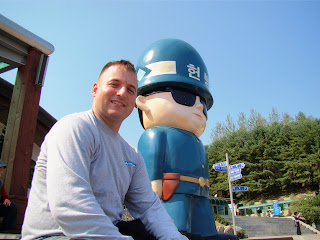
Resting after running up the steep .5 mile ramp out of the tunnel.
 The view from Mt Scott.
 Spencer being serious.
 I like Lily's little leg kick.

 King of the mountain.
 Medicine Park, OK a nice little resort town on the north side of the refuge.
 Smelly bison.

 The kids loved the prairie dogs.
 Longhorn steers where everywhere.